
Africa will make history at the FIFA World Cup 2026 as 10 teams represent the continent, marking the largest African presence ever recorded at the tournament.
The competition begins on Thursday in North America, with South Africa taking on co-hosts Mexico in the opening fixture. For the first time, Africa will field double-digit representation on football’s biggest stage.
Algeria, Cape Verde, Côte d’Ivoire, DR Congo, Egypt, Ghana, Morocco, Senegal, South Africa and Tunisia will carry the continent’s hopes at the expanded 48-team tournament hosted across Canada, Mexico and the United States.
The milestone represents a significant moment for African football, arriving four years after Morocco became the first African nation to reach a FIFA World Cup semi-final at Qatar 2022.
This expansion in representation offers Africa a broader platform to build on that breakthrough and to push further than ever before in pursuit of deep tournament runs.
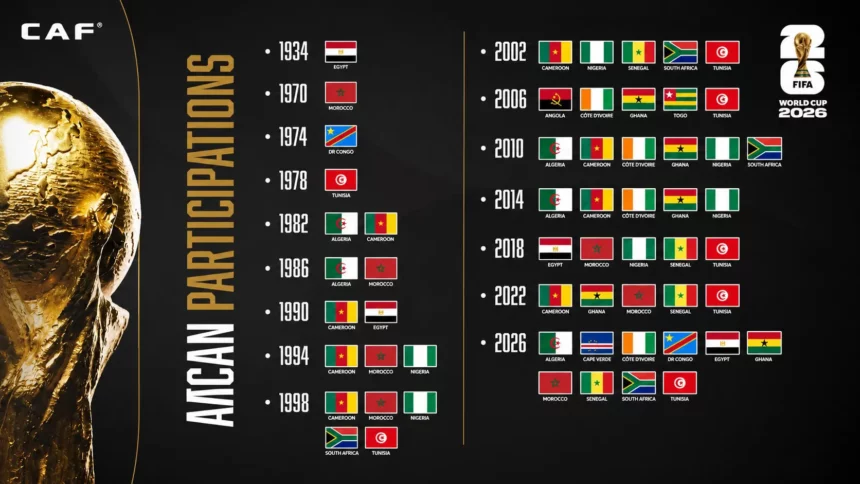
Africa’s World Cup journey dates back to 1934, when Egypt became the first nation from the continent to appear at the finals.
For many decades, African participation remained limited.
Morocco became the second African representative in 1970, followed by DR Congo—then competing as Zaire—in 1974.
Tunisia joined in 1978, before Algeria and Cameroon appeared at the 1982 edition.
By 1986, Algeria and Morocco were once again the continent’s sole representatives, while Cameroon and Egypt featured in 1990.
The 1994 tournament saw Cameroon, Morocco, and Nigeria represent Africa, before the continent reached five teams for the first time in 1998 with Cameroon, Morocco, Nigeria, South Africa, and Tunisia.
That five-team presence continued in 2002, featuring Cameroon, Nigeria, Senegal, South Africa, and Tunisia, before Angola, Côte d’Ivoire, Ghana, Togo, and Tunisia qualified for the 2006 World Cup.
Africa’s previous record came in 2010, when six teams participated at the tournament hosted on African soil in South Africa.
Algeria, Cameroon, Côte d’Ivoire, Ghana, Nigeria, and South Africa all competed, with Ghana narrowly missing out on the semi-finals after a penalty shootout defeat to Uruguay.
In 2014, the continent was represented by Algeria, Cameroon, Côte d’Ivoire, Ghana, and Nigeria.
Egypt, Morocco, Nigeria, Senegal, and Tunisia qualified for the 2018 edition, while Cameroon, Ghana, Morocco, Senegal, and Tunisia represented Africa in Qatar 2022.
Morocco’s historic run in Qatar reshaped global perceptions of African football at the World Cup.
The Atlas Lions defeated Belgium, Spain, and Portugal en route to the semi-finals, delivering the continent’s strongest-ever performance on the global stage.
Now, with 10 African teams involved, the continent has even greater opportunity to produce another historic breakthrough.
Cape Verde’s qualification stands out as one of the tournament’s most remarkable stories, with the island nation set to make its World Cup debut.
DR Congo also return to the global stage for the first time since 1974, adding another compelling narrative to Africa’s presence.
South Africa’s return carries major significance as well. Bafana Bafana will feature at the World Cup for the first time since hosting the tournament in 2010, and they open the competition against Mexico in a fixture rich in symbolism.
Ghana, Senegal, Morocco, Tunisia, Algeria, Egypt, and Côte d’Ivoire bring valuable World Cup experience, while Cape Verde and DR Congo inject fresh energy into Africa’s challenge.
For the continent, the 2026 World Cup is about more than numbers.
It is about converting record representation into record performance.
While the expanded format offers more opportunities, it also raises expectations significantly.
After years of near misses, dramatic exits, and historic moments, Africa arrives in North America with its strongest-ever presence.
From Egypt’s debut in 1934 to 10 teams in 2026, the journey has been long, complex, and historic.
Now the continent faces another opportunity to demonstrate that its place at the World Cup is not only expanding in numbers, but also in ambition and impact.
African Participation at the FIFA World Cup
1934: Egypt
1970: Morocco
1974: DR Congo
1978: Tunisia
1982: Algeria, Cameroon
1986: Algeria, Morocco
1990: Cameroon, Egypt
1994: Cameroon, Morocco, Nigeria
1998: Cameroon, Morocco, Nigeria, South Africa, Tunisia
2002: Cameroon, Nigeria, Senegal, South Africa, Tunisia
2006: Angola, Côte d’Ivoire, Ghana, Togo, Tunisia
2010: Algeria, Cameroon, Côte d’Ivoire, Ghana, Nigeria, South Africa
2014: Algeria, Cameroon, Côte d’Ivoire, Ghana, Nigeria
2018: Egypt, Morocco, Nigeria, Senegal, Tunisia
2022: Cameroon, Ghana, Morocco, Senegal, Tunisia
2026: Algeria, Cape Verde, Côte d’Ivoire, DR Congo, Egypt, Ghana, Morocco, Senegal, South Africa, Tunisia